Reprint
from Sierra Leone Studies, New Series, no. 5, December 1955
Notes on Bai Bureh, of 1898 fame
by
Douglas W. Scotland
My object in submitting these notes, which I have collected from books and papers, detailed at the end of this article, is the hope that further facts and information will be supplied on this great Temne leader before he becomes a legendary figure and before truth is obscured by the mist of time, making it difficult to sort out the facts from fiction. He died at Rogbalan in Kasse chiefdom in 1908 so there might be still many in his country that knew him in his latter years and heard from his own lips his many deeds of prowess.
I remember clearly the first occasion on which I heard of Bai Bureh. It was soon after I arrived in Freetown in early 1911 when I asked my Temne servant what his age was. He stated that he was a boy following his mother in the bush during the Bai Bureh war and that "hungry go catch we bad". That was the first of many occasions during my service in the Protectorate of Sierra Leone that I found events were dated from the Bai Bureh war, when his leadership imprinted on the people of his time such a lasting impression. As I left Sierra Leone twenty six years ago, I wonder whether the Temne people still keep alive their memory of him.
The Kasse chiefdom lies to the NNE of the Port Lokko chiefdom (Maforki), it is bounded on the north by the Mabole river and on the west by the Little Skarcies river. At the present day it is quite a small chiefdom, probably 100 square miles in extent. Before the formation of the Protectorate, Kasse was perhaps a larger chiefdom as such a successful war leader as Bai Bureh must have extended his power and influence beyond the confines of the present Kasse chiefdom.1
Braithwaite Wallis states that Bai Bureh was sometimes called Kabalai.
1 This chiefdom was always small, and no boundaries were deliberately altered by government in 1896. Bai Bureh's influence, howcver, did extend beyond it. (Editor)
Sir David Chalmers in Part 1 of his Report on the subject of the Insurrection in the Sierra Leone Protectorate informs us that Bai Bureh came into much prominence as a war leader during the war between the Temnes and Susus when he, fighting for the former in 1873 and 1876 had extraordinary success. He had fought in alliance with the British but he had not always been on the best of terms with them.
With reference to the above intertribal war palavers, both Chalmers and Crooks wrote signifiicant words of marked consequence relating to Chief Bai Bureh. The former writer stated that Bai Bureh refused to go to Port Lokko to meet the Governor unless guaranteed against arrest to which he had evidently a strong aversion. He came upon the required guarantee being given and was fined. Crooks states that during the 1890 war Mr Garrett endeavoured to induce Bai Bureh to accompany him to Freetown but without success. Sir F. Cardew stated in his reply to Chalmer's Report that Bai Bureh "twice before, in 1890 and 1894, had successfully resisted arrest by means of his war boys".
The above incidents occurred previous to the formation of the Protectorate in 1896. The chiefdoms were under tribal rule except that many had made treaties with the British. The terms of these treaties varied. Bai Bureh and his chiefdom never made any treaty with the British government with whom he had no ties. He was an independent chief as the above and following events proved.
In 1896 the tribes and chiefdoms were brought by ordinance under the
 As the government was determined
now to enforce the law, the means
available at that time were mobilized for the collection of this tax in
January, 1898. When the time came, many chiefs and people refused to
pay or made excuses. Among these those of the Temne tribe were
outstanding. Chiefs and leaders were fined or imprisoned for refusal to
obey the law. Open revolt really started at Port Lokko. The District
Commissioner left Karene, his headquarters, for Port Lokko in early
February, 1898, with the object of starting tax collecting in this
populous trading centre. The District Commissioner soon found that the
natives and non-natives refused to pay or co-operate through fear of
Bai Bureh who threatened dire consequences on any who paid. Some
leaders were imprisoned and many natives and non-natives fined. The
payment of fines became a farce. In the end the District Commissioner
was determined to arrest Bai Bureh, the power behind the resistance.
The District Commissioner, previous to this, sent a letter to Bai Bureh
requesting him to come in and pay his tax. This letter was the cause of
lengthy inquiry by Sir David Chalmers as the District Commissioner
stated that Bai Bureh returned to him this letter unopened with a
contemptuous and defiant message. Whereas the Bai stated that he never
received this letter and therefore he was never requested by the
District Commissioner to pay the tax. The District Commissioner's
messengers with the letter were apparently stopped by the Bai's war
boys and sent back to the District Commissioner. There is, however, no
doubt that this chief was fully aware of the fact that the District
Commissioner was after him for the tax and for his arrest. His
well-organized spy system kept him informed of everything that was
going on in Port Lokko, so he knew of the District Commissioner's
threat to arrest him.1 Besides Bai Bureh never intended to
pay the tax. He was the power behind the resistance and he knew it.
As the government was determined
now to enforce the law, the means
available at that time were mobilized for the collection of this tax in
January, 1898. When the time came, many chiefs and people refused to
pay or made excuses. Among these those of the Temne tribe were
outstanding. Chiefs and leaders were fined or imprisoned for refusal to
obey the law. Open revolt really started at Port Lokko. The District
Commissioner left Karene, his headquarters, for Port Lokko in early
February, 1898, with the object of starting tax collecting in this
populous trading centre. The District Commissioner soon found that the
natives and non-natives refused to pay or co-operate through fear of
Bai Bureh who threatened dire consequences on any who paid. Some
leaders were imprisoned and many natives and non-natives fined. The
payment of fines became a farce. In the end the District Commissioner
was determined to arrest Bai Bureh, the power behind the resistance.
The District Commissioner, previous to this, sent a letter to Bai Bureh
requesting him to come in and pay his tax. This letter was the cause of
lengthy inquiry by Sir David Chalmers as the District Commissioner
stated that Bai Bureh returned to him this letter unopened with a
contemptuous and defiant message. Whereas the Bai stated that he never
received this letter and therefore he was never requested by the
District Commissioner to pay the tax. The District Commissioner's
messengers with the letter were apparently stopped by the Bai's war
boys and sent back to the District Commissioner. There is, however, no
doubt that this chief was fully aware of the fact that the District
Commissioner was after him for the tax and for his arrest. His
well-organized spy system kept him informed of everything that was
going on in Port Lokko, so he knew of the District Commissioner's
threat to arrest him.1 Besides Bai Bureh never intended to
pay the tax. He was the power behind the resistance and he knew it.1 It was Governor Cardew, not the District Commissioner, who gave orders for Bai Bureh's arrest. See his dispatches in the Public Record Office, C.O. 267/410, continued 47,74 (Editor.)
stockades and ambuscades were a continual trial and hindrance to the troops. The war boys were in considerable force around Kabantama and Masumbala where there was a good deal of firing. Eventually the force arrived at Karene late that afternoon and found the country in revolt and the chiefs from the north and east were sending their war boys to aid Bai Bureh. As the government was determined to hold Karene, this station was soon besieged and assaulted by the war boys. This state of affairs continued for about a fortnight when the station was relieved by a strong force from Port Lokko. The object of the British was to keep the communication between Port Lokko and Karene open. With this object in view their forces had been considerably increased but Bai Bureh's war boys continually stockaded and ambushed the British convoys on the march. As this road passed through dense forest the war boys, unseen and in great numbers, continued their harrassing tactics, causing loss of troops, carriers and many valuable loads of provisions and military equipment. The British were no nearer capturing Bai Bureh. A reward of £50 was offered for Bai Bureh's capture.
On the 1st April Col. Marshall arrived to study the position. As the long marches from Port Lokko to Karene were being kept up at considerable sacrifice of officers and men, Col. Marshall established intermediate posts and instead of troop movements in large numbers small detachments were sent out in all directions. In spite of this the war boys remained in the forests and lay concealed behind stockades and gigantic trees, thus causing little risk to themselves and at the same time being in a position to shoot down the British.
The British movements were cumbersome for narrow paths through forest
The penetration in to the Kasse chiefdom and the surrounding territory by small mobile British forces and the "Scorched earth" policy resulted in the Bai being a hunted and harried person. Then the rains set in with rivers in spate and land flooded.
While the fighting was in progress nearly all non-combatants fled to other parts of the country. The Temnes had skilfully hidden supplies of food in the form of cassada and rice and there is no doubt that the combatants received help in food and arms from adjoining sympathetic chiefs and even supplies were obtained from French country as the Bai was well supplied with gold; further they captured from the British many abandoned loads of food and military stores. In spite of these sources of supply, as always the rains are the hungry season in Sierra Leone and owing to the war in those parts the whole of the farming economy was upset. Hunger and propects of famine the following year damped the ardour and spirits of the leaders and war boys and many faded away from the devastated area.
The British left a large garrison with six months provisions at Karene and the remaining troops returned to Freetown on the 10th July, 1898.
The natives had a quicker and more effective method of sending information by what is commonly termed "bush telegraph", whereas the British used carrier pigeons and native runners; the latter were not so successful owing to the vigilance of the war boys along all paths. Bai Bureh, having fought with and against the British was familiar with their tactics and methods. Being the general he was he used to the fullest extent this experience and knowledge.
Bai Bureh's war was against the British govenment. The traders and missionaries were absolutely at his mercy but there were no plundering raids and not a trader or missionary was killed. The only exception being the missionary, Mr. Humphreys, who lost his life through insisting on going on a journey along a particular road against the warnings of the war boys who killed him on their accord and not by order of any one in authority. The Rev. Mr. Elba, in his interview with Bai Bureh, said in his evidence taken by Sir David Chalmers, that the Bai "appeared to be sorry of the occurrence". Braithwaite Wallis stated that a Mr. Cole, a trader in Kasse, informed him also of his regret and that he had caused the four men who had committed the murder to be put to death in the same manner they had killed Mr. Humphreys.
Wallis said that Bai Bureh "proved to be a soldier and a man".
Compared with Bai Bureh's war, the Mendi rising was a barbaric affair
After the 10th July 1898, when the main British forces were withdrawn, the troops garrisoning Karene were active in penentrating all parts of the surrounding country. The hunt for Bai Bureh, who was hard pressed, finally came to an end in August, when "A" Company of the West African Regiment, commanded by Capt. Goodwyn, captured the Bai.
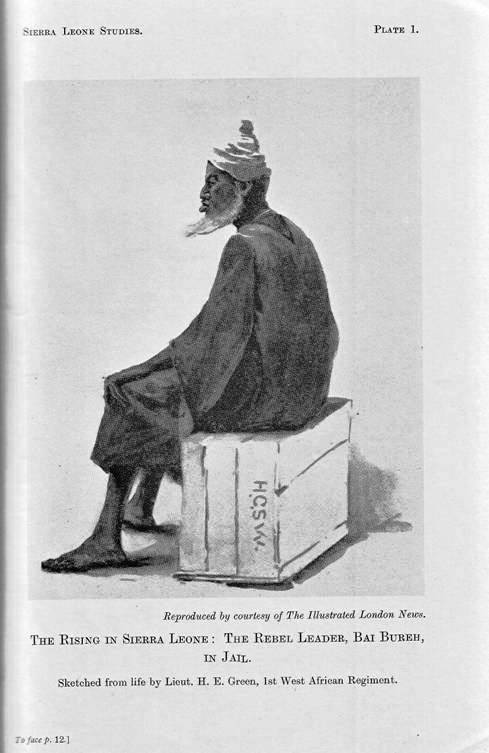
He was detained in Freetown jail and in the latter half of 1899 he was deported to the Gold Coast. Lieut. H. E. Green, of the Essex Regiment and attached to the 1st West African Regiment, made a sketch from life of the Bai while he was in prison. This sketch with a short article appeared in The Illustrated London News of 24th December, 1898. Through the courtesy of the Editor of this paper, the sketch is reproduced. It shows a man with a white protruding beard of an aggressive appearance and a profile of great character, of determination and energy.
The Bai returned to Sierra Leone on the 17th July, 1905, and in September, 1905, resumed office as Paramount chief of the Kasse chiefdom with his chief town at Rogbalan. The date of his death is uncertain but he probably died in 1908. The fact of his deportation did not deprive the Paramouont chief of his chieftaincy, by Temne law only on death the chiefship passes to the successor. A Temne chief is both a spiritual and temporal head of his people, his divine origin being Futa in French territory, whence he returns on death to join his predecessors and from whence the new chief is said to arrive at his crowning. Therefore the presence of the dead chief in his chiefdom is really essential for his funeral rites and the crowning of his successor.
Bai Bureh avoided capture in a very limited area, for over six months. He was a great warrior and leader and a humane person. An outstanding man of his time in the Temne nation.1
1 It is interesting to note that Joseph Chamberlain was anxious to let Bai Bureh off with a fine and a caution - "he has rather enlisted my sympathy" - and would rather have liked to see him in the future administration of the Protectorate. But Acting Governor Nathan preferred to deport him. See Public Record Office C.O. 267/443, 446. (Editor.)
REFERENCES
CROOKS J. J., A History of Sierra Leone
SIBTHORPE, A. B. C. History of Sierra Leone
BRAITHWAITE WALLIS, C. The Advance of Our West African Empire.
Report by Her Majesty's Commissioner and Correspondence on the Subject of the Insurrection in Sierra Leone Protectorate, 1898, Part 1. Report and Correspondence. (C.9388).
The Illustrated London News of 24th December, 1898.
SIBTHORPE, A. B. C. History of Sierra Leone
BRAITHWAITE WALLIS, C. The Advance of Our West African Empire.
Report by Her Majesty's Commissioner and Correspondence on the Subject of the Insurrection in Sierra Leone Protectorate, 1898, Part 1. Report and Correspondence. (C.9388).
The Illustrated London News of 24th December, 1898.